How to Take Your European (Schengen) Visa Photo
Overview
When you apply for a Schengen (short-stay) visa you must submit two identical passport-style photographs with your application. These are biometric photographs used to identify you, and they must meet specific technical and appearance rules. Follow this guide to prepare, take, and validate photos that comply with Schengen requirements and avoid common mistakes.
Key technical specifications
- You must provide 2 identical photos.
- Photos must be in color (no black and white).
- Size: 35 mm wide × 45 mm high.
- Photos must be not older than six months.
- Minimum printing/printing-resolution: 400 dpi.
- Head should occupy 70–80% of the photo.
What “biometric photo” means
A biometric photo is a standard photograph that fits the above criteria and clearly shows your face and identifying details. These photos are used on official documents, including visa applications.
Facial expression and pose
- Look straight at the camera.
- Maintain a neutral facial expression — do not smile; keep your mouth closed.
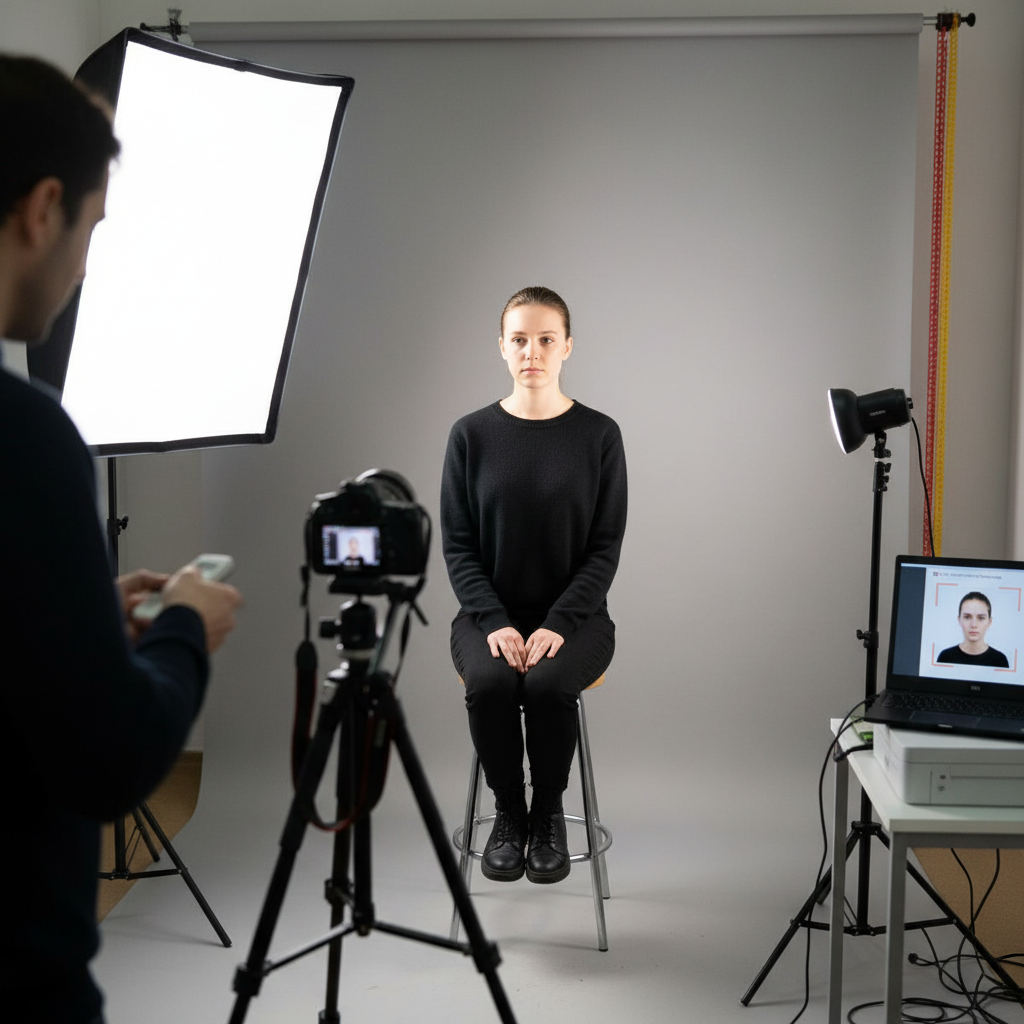
- Ensure even brightness across your face with no shadows.
Hair, face visibility and general appearance
- Use your normal haircut; do not change appearance dramatically before applying.
- Your face must be clearly visible from the bottom of your chin to your forehead.
- Avoid clothing that matches the background.
Glasses, sunglasses and tinted lenses
- Sunglasses and dark optical glasses are not allowed.
- If you wear glasses: eyes must be fully visible, lenses fully transparent, and there must be no distortion caused by reflections and no shadow from the glasses on your face.
Head coverings and religious exceptions
- Hats, headwear that covers the face, or headwear that casts shadow on the face are prohibited.
- Religious head coverings are allowed only if the face is fully visible from chin to forehead.
- When wearing religious headwear it must be plain, one color, and contrast with the background.
Background requirements
- Background should be a light, plain color; light gray is suggested.
- Patterns are not allowed.
- It is suggested you avoid a white background — choose a light gray or similar color.
Lighting and photo quality
- Avoid reflections, shadows and red-eye.
- Ensure even brightness and no shadows on your face.
- Photographs must reflect your natural skin tone.
- Do not crease the photograph.
Printing and paper
- Schengen photos must be printed on high-quality paper.
- Printing resolution must be at least 400 dpi.
- Photo booths and professional photographers will usually use acceptable paper and printing standards.
- Printed photos are the accepted form.
How many photos to bring
- Always provide the two required photos for a short-stay Schengen visa.
- If applying for a visa other than a short-stay (longer than 90 days) you may be asked for additional passport-standard photographs — it’s wise to have spare pictures available.
Uniformity across Schengen countries
- The standard passport photograph size and requirements are uniform across all Schengen Area countries.
Common reasons for rejection
- Wrong size or proportions (head not occupying 70–80%).
- Photo older than six months.
- Black-and-white photo.
- Patterned or incorrect background color (e.g., white if advised against).
- Smiling, head turned, or eyes not fully visible.
- Reflections, shadows, red-eye, uneven brightness.
- Glasses causing reflections or hiding eyes.
- Poor print quality or low resolution.
What happens if your photo is rejected
If your photo does not meet the requirements you will need to submit a compliant photo. Failure to correct this early may require you to reapply for the visa.
If your appearance has changed
Biometric photos are intended to still identify you even if you have changed your appearance (e.g., hair growth or new glasses). However, avoid dramatic changes to your look before applying.
Practical, actionable steps before taking the photo
1. Check you have two identical sheets of a printed photo, 35×45 mm, in color, taken within the last 6 months.
2. Use a plain light-gray background if possible; avoid patterns and white if suggested.
3. Stand straight, look directly into the camera, keep a neutral expression with mouth closed.
4. Ensure your head fills 70–80% of the photo frame.
5. Remove sunglasses and dark lenses; if you wear glasses ensure lenses are transparent and reflections are absent.
6. Avoid clothing that matches the background; choose contrasting, plain clothes.
7. Use even, diffuse lighting to prevent shadows and red-eye.
8. Print on high-quality paper at 400 dpi or have a photo booth/professional do the print.
9. Don’t crease the photos; carry spares in case additional images are requested.
Final validation checklist before submission
- Two identical color photos, 35×45 mm, not older than 6 months.
- Head occupies 70–80% of the photo.
- Neutral expression, mouth closed, looking straight at camera.
- Light plain background (light gray suggested), no patterns.
- No shadows, reflections, or red-eye; even brightness.
- Glasses allowed only if eyes fully visible and no reflection/distortion.
- Religious headwear allowed but face fully visible; head covering must be plain and contrast with background.
- Printed on high-quality paper at ≥400 dpi, natural skin tone, uncreased.
Follow these requirements carefully to reduce the risk of rejection and delays in your Schengen visa application. If in doubt, use a professional photographer or a trusted photo booth — they will usually produce prints that meet the stated standards.