How to Take Your European (Schengen) Visa Photo
Overview
Getting the photo right is one of the simplest ways to avoid delays when applying for a Schengen visa. The photograph must meet specific technical and compositional rules: size, face position, background, lighting, facial expression, and print quality.
Main size and print specifications
The photo measurements must be 35 x 45 mm. Two identical photos must be submitted with your application. Photos must be color, of professional quality, and printed on high-quality matte or glossy paper with at least 600 dpi resolution.
Face and head coverage
The face must cover roughly two thirds of the photograph. The head height should be within 32–36 mm — this normally corresponds to about 70–80% of the image. Make sure the face is centered and no part of it is cut off; leave some space above the head and show the top of the shoulders.
Image quality and contrast
The image must be clear, sharp and with sufficient contrast. Blurry, low-contrast, excessively bright or overexposed/underexposed images will most probably be rejected. The photograph should demonstrate natural skin tones.
Lighting: avoid shadows and glare
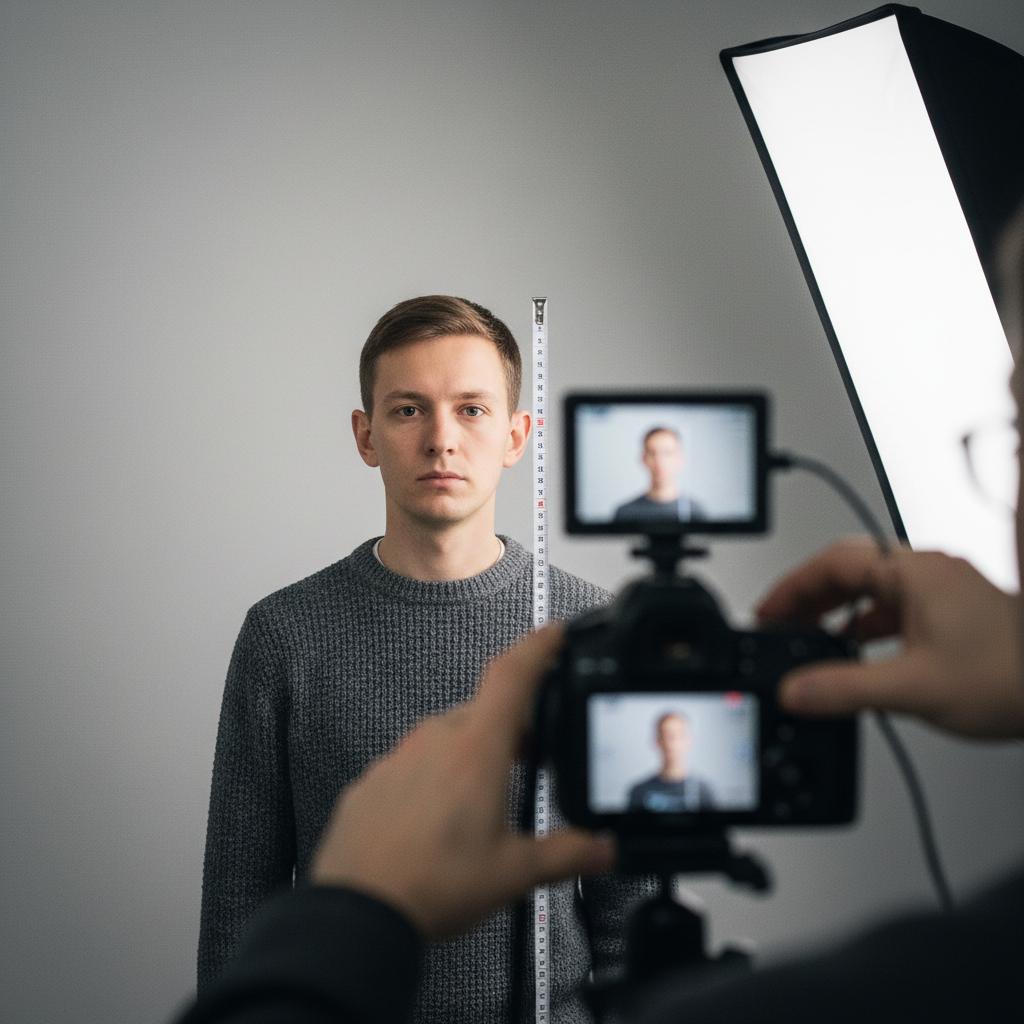
No reflections or shadows are allowed on the face or behind the head. Avoid flash reflections and glares on glasses. The best source of light for the picture is daylight with the window behind the camera. If you use bulbs, place two light sources at about a 45° angle to the face at eye level.
Pose and facial expression
The photo must display a full frontal view of the face with a neutral facial expression. Look straight at the camera, keep your mouth closed, and do not smile or raise your brows. Tilted heads, looking away, or three-quarter portraits are not accepted.
Background requirements
The background must be plain and bright but should not be white. Neutral grey is recommended because it gives the hair and face the needed level of contrast. Avoid patterns, textures, or any objects appearing in the background.
Glasses and reflections
If you wear glasses, you may keep them on only if the frames are not heavy and do not cover your eyes. No reflection or glare from glasses is allowed. Sunglasses and tinted spectacles are not permitted.
Head coverings, hair and accessories
Fashion headwear and jewelry are forbidden. Head coverings are allowed only for religious or medical reasons, and even then they must not cover any part of the face. Keep hairstyles neat and make sure long hair does not block the face.
Red-eye and digital defects
No photos are allowed with red eyes. The photograph must be free of reflections, glare, and any digital artifacts that reduce sharpness or contrast.
Special rules for babies and children
Each baby requires their own passport and Schengen visa photo. A baby may be photographed seated or lying on the floor; use a grey blanket for contrast. No group photos. If someone needs to support the baby, hide the supporting hand under the cover so it is not visible. Ensure uniform lighting so there are no shadows across the baby’s head or on the background. Dummies, bottles and toys are not permitted in the photo. Infants should have their eyes open and mouth closed and look straight at the camera, but this rule is flexible for newborns.
Practical step-by-step: taking the photo at home
1. Choose a plain neutral grey background and set it up where you get good daylight with the window behind the camera.
2. Position the camera at eye level, far enough to include shoulders and leave some space above the head.
3. Use two soft light sources at about 45° eye level if daylight is insufficient.
4. Ask the subject to look straight at the camera, keep a neutral expression, and keep the head centered.
5. Take multiple shots to ensure sharp focus, correct exposure, no shadows and no reflections on glasses.
6. Crop the final image to 35 x 45 mm, ensuring head height is 32–36 mm (approximately 70–80% of the image).
Using software to validate and prepare photos
You can use a photo-editing tool such as Passport Photo Maker to help meet the requirements. The program can auto-detect faces and crop correctly, enhance contrast, sharpen the image, remove red-eye, and prepare print layouts. Choose the correct Schengen template within the program and confirm the crop matches the 35 x 45 mm and head height rules.
Printing and final checks
Print on high-quality matte or glossy paper at a minimum of 600 dpi. Make two identical prints. Inspect the prints for accurate color, no shadows, no reflections, full frontal view, neutral expression and correct size before attaching them to your application.
Common mistakes to avoid
- Using a white background instead of a neutral grey.
- Overexposed or underexposed images or visible shadows.
- Cropping too tightly so the top of the head or shoulders are cut off.
- Wearing heavy-framed glasses or sunglasses.
- Including toys, hands or other people in baby photos.
- Printing at low resolution or on low-quality paper.
Submission checklist (actionable)
- Photo size: 35 x 45 mm.
- Two identical color photos printed on high-quality paper (≥600 dpi).
- Head height 32–36 mm (about 70–80% of the image), face centered.
- Full frontal view, neutral expression, mouth closed.
- Plain bright background (preferably neutral grey).
- No shadows, reflections, red eyes or glare.
- No heavy glasses, no fashion headwear; medical/religious headwear allowed if face is fully visible.
- Babies: single subject per photo, no toys/bottles, support hidden if needed.
Final advice
Double-check every technical requirement before you print and submit. If unsure, retake photos under better lighting, use the auto-cropping and validation features of a dedicated ID-photo program, or have a professional photographer prepare the two identical prints to avoid rejection and delay.